
If you’ve been teaching English for any length of time, you’ve definitely heard students say…

Beyond Do and Does: How to Teach WH- Questions in Your Online English Classroom
In our last week’s article, we explored how to teach do/does and don’t/doesn’t effectively in your online English classroom. Once students become comfortable asking and answering simple yes/no questions like “Do you like broccoli?” or “Does she play golf?”, they’re ready for the next step: WH- questions.
WH- questions help students gather specific information and have more meaningful conversations. They’re essential for everyday communication and appear constantly in both spoken and written English.

In this week’s article, we’ll look at how to teach what, where, when, why, who, and how questions using do and does, along with some simple tricks to help your students remember the correct word order.
Why WH- Questions Matter
Imagine trying to have a conversation using only yes/no questions: “Do you travel?” “Do you work online?” “Do you like hiking?” You’d learn very little information about the other person and it can get quite boring, quite fast.

WH- questions open things up. Instead of dead ends, students can ask:
- Where do you usually travel to?
- What do you do for work?
- Why do you enjoy hiking?
This shift moves students from basic communication to genuine conversation.
Introduce the Question Words

Before diving into grammar structures, make sure students understand what each question word is actually asking for:
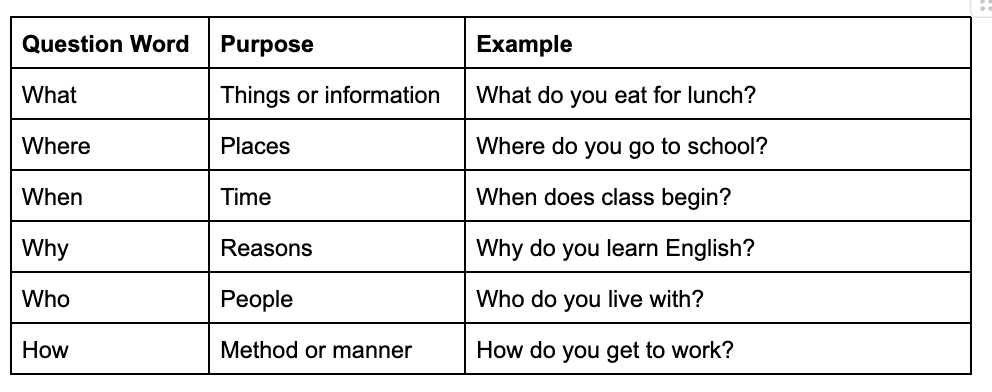
Taking a few minutes here pays off. Students who understand the purpose of each word make far fewer errors when forming questions.
Teach the Sentence Structure
Once students know their question words, introduce this simple formula:
WH- word + do/does + subject + base verb
Having a predictable pattern is reassuring for learners at this level. Write the formula at the top of your shared screen and refer back to it throughout the lesson.

Tip: Use colour coding. Assign a color to each part of the formula as visual learners especially benefit from seeing the same pattern highlighted consistently.
For example:
- WH- word = Blue
- Do/does = Green
- Subject = Red
- Base verb = Purple
By writing or highlighting the words in different colours, students repeatedly see the same pattern and begin to recognize it automatically.
You can also give students a phrase-based memory trick: Question Word + Do/Does + Person + Action
Many students find this sequence easier to remember than traditional grammar terminology.
Exercises to Build Accuracy
1) Unscramble the question.
Mix up the words in a question and ask students to put them in the right order, kind of like rearranging train cars.

For example: work | you | where | do
Students arrange these into “Where do you work?”
This activity works particularly well with younger learners and beginner adults.
2) Correct the mistakes.

Many students transfer sentence structures directly from their native language, which leads to errors like:
- Where you live?
- Why she studies English?
- What he does after school?
Put a few of these on your shared screen and ask students to fix them. It’s a good opportunity to reinforce the idea that English questions need a helper word. Once students internalize the role of do and does, their accuracy tends to improve quickly.
3) Create the question from the answer.
This is the most challenging of the three. Give students an answer and ask them to work backwards to form the question.
For example: I eat sandwiches for lunch on Mondays.
Possible questions:
- What do you eat for lunch on Mondays?
- When do you eat sandwiches for lunch?
When multiple questions are possible, highlight the differences. It deepens students’ understanding of how meaning shifts depending on which word they lead with.
Fun Activities to Keep It Engaging
1) Guess the Mystery Person

Think of a famous person and have students ask WH- questions to figure out who it is.
For example:
- Where does this person live?
- What do they do?
- Why are they famous?
Students can also take turns being the one in the hot seat, choosing their own mystery person while classmates question them.
2) Question Cube

Create a virtual or physical cube with one question word on each face: Who, What, When Where, Why, How. Students roll the cube, form a question using the word that comes up, and direct it to a classmate. Once that classmate answers the question, then it’s their turn to roll the cube and the game continues until every student has had a chance to speak.
We hope this article gives you some fresh ideas for teaching WH- questions with do/does. Let us know which grammar points you’d like us to tackle next, and subscribe to LatinHire’s Weekly Newsletter to stay in the loop.

Related Posts